
The Five Levels of AI Adoption
I’m meeting a lot of business owners that say they are “using AI.”
But there is a big difference between occasionally asking AI a question and actually using it to improve how your business operates.
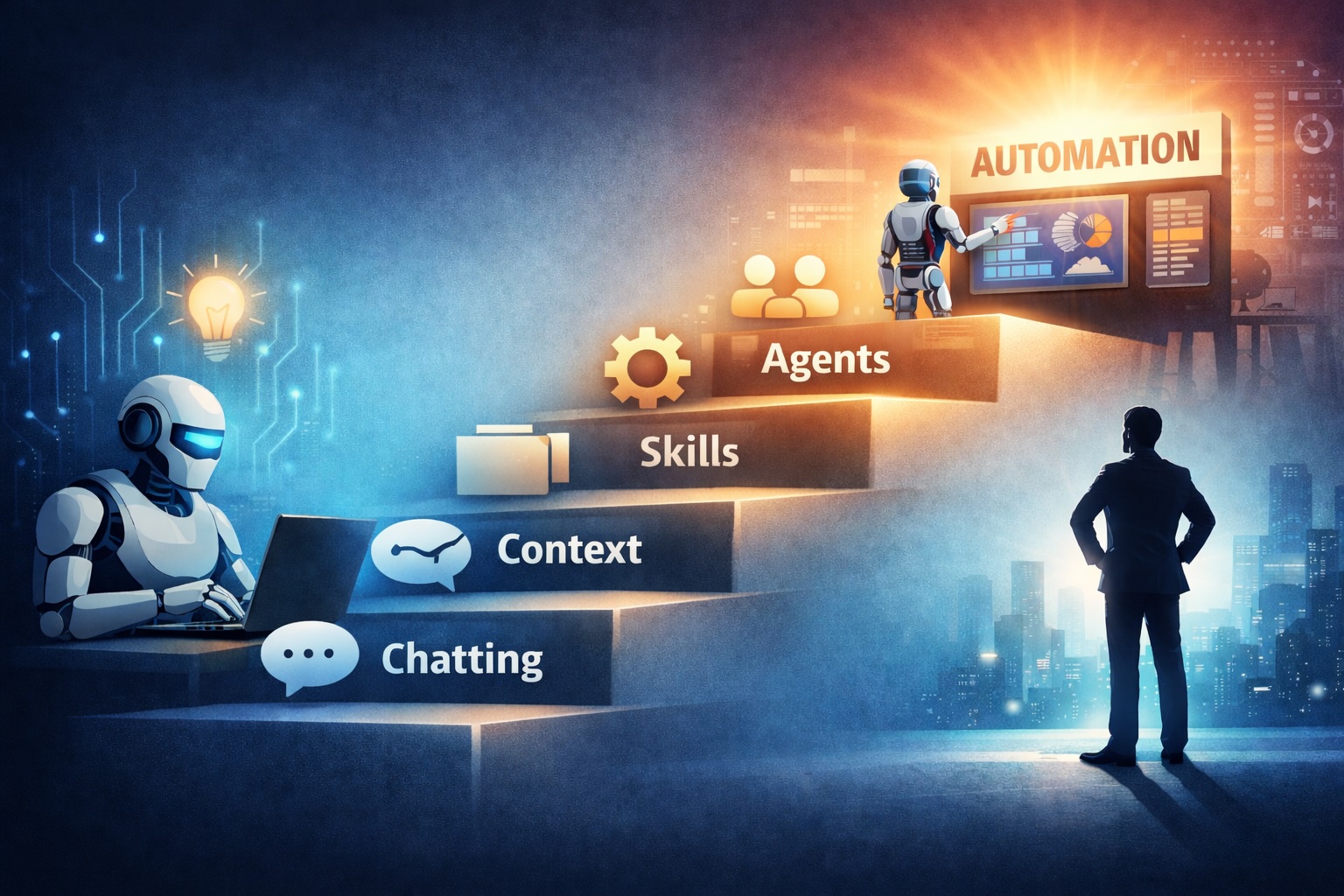
One way to think about this is through five levels of AI Adoption. Most businesses start at level one and slowly work their way up as they discover what is possible.
Here is what that progression looks like:
Level 1: Chatting
This is where almost everyone begins.
You open an AI tool and type a quick prompt.
Example:
“Write an email about [something].”
You get a response, maybe edit it a little, and move on.
This can be useful, but the leverage is fairly low. You are still doing most of the thinking and directing each time you use it.
It saves a little time, but it does not fundamentally change how your business runs.
Level 2: Context
The next step is giving AI better information.
Instead of starting with a blank prompt every time, you provide background materials and documents.
Examples include:
Your brand guide
Website copy
Product descriptions
Sales materials
Once AI understands your business, the quality of the output improves dramatically. The responses become more accurate and more aligned with your voice and positioning.
At this level, AI begins to feel less like a generic tool and more like an assistant that understands your business.
Level 3: Skills
This is where things start to get powerful.
Instead of writing new instructions every time you use AI, you create reusable instructions that it can follow repeatedly.
Think of these as repeatable playbooks or SOPs.
For example, you might create a structured set of instructions for:
Writing social posts
Creating blog outlines
Turning reviews into testimonials
Producing marketing emails
Once the instructions exist, the AI can follow them again and again.
This is the first real multiplier. Instead of starting from scratch each time, you begin building systems.
Level 4: Agents
At this level, you stop working with just one AI assistant.
Instead, you create multiple AI workers that each have a specific role.
For example:
A researcher that gathers information
A writer that drafts the content
An editor that reviews and improves the final version
Each one handles a different part of the process.
This starts to resemble a small team rather than a single tool.
Level 5: Autonomous Workflows
The final level is when AI becomes part of an automated system.
Instead of manually triggering each task, the process runs on its own.
For example:
AI gathers information
Produces content
Reviews it
Prepares it for publishing
At this level, AI is no longer just helping you complete tasks faster.
It is helping your business operate more efficiently by handling routine work automatically.
Where Most Businesses Are Today
Most small businesses are still at Level 1. They occasionally ask AI a question or generate a piece of content.
Very few have moved into Levels 3, 4, or 5 where the real leverage begins.
The opportunity right now is for business owners who learn how to move up the ladder and use AI as part of their operating system rather than just a writing tool.
Most businesses are still using AI as a basic tool. The real advantage comes when you begin turning it into systems that save time, reduce effort, and help your business run more smoothly.
At Rock Ridge Media, we focus on installing smart marketing systems that help small businesses work more efficiently and capture more opportunities automatically.
Meanwhile, ask yourself, "Did he make that picture mildly frightening on purpose?"